
by Marc Lougee / March 11, 2026
Lionsgate’s “The Long Walk” film adaptation, written by JT Mollner, directed by Francis Lawrence
Original story by Stephen King
A little backstory:
I was 14 and working for a summer stock theatre company in Wolfeboro, New Hampshire—building sets, ushering shows, and occasionally running the light board during matinees. The cast and crew were from New York City, and it was the first time I’d been around people actually working in theatre, film and television. They were great: patient, protective, and endlessly encouraging of the kid with a lot of questions. Like me, these fine folks were big fans of Ray Harryhausen, Star Wars and comic books. We spent many hours talking late into the night, as they patiently filled in the gaps for me on miniatures, monsters, animation, and special effects. It was my introduction to the nuts and bolts of how this stuff worked. So cool.
I fit in with this bunch. Best summer ever.
Most nights, I just crashed on the floor of the crew cabins, reading comic books and paperbacks left behind by the rotating crew. Digging around in the boxes search of heroic adventures, my boss handed me a copy of “The Long Walk” (by Richard Bachmann, Stephen King’s pseudonym). He told me this could be interesting. The cover caught my eye, and I dove in.
The story hit me hard- it took a few days for me to understand why.
Being from a small town in New England myself, I related to Ray Garraty and his restless urge to do something to change his future. What struck me about the story was that each of the fellows involved had hopes and plans to alter their trajectories, even at great cost to themselves. Like the young guys in the story—most of them not much older than I was—I felt the pull to go beyond the usual paths to follow. I wanted to try for something bigger, to see what might be possible. Clearly, none of this was going to be easy, if not damn near impossible for a geeky young kid, but I was naive and ready for a challenge to prove myself.
So late the following summer, at the worldly-wise age of fifteen, I came up with my own plan. Setting my hare-brained scheme in motion, I pitched The Plan to my mother. Realizing resistance was futile, she let me head off, thinking I’d be back when I got hungry. Off I went, making my way from Sanbornville, NH, to Boston, MA.
The City.
I got as close as the suburbs, where I’d found a high school with promising opportunities, so I set my sights on getting in the door. A solo traveller of sorts, I had to employ a bit of creative document manipulation, illegible signatures and a random address from a phone book to get past the gatekeepers (bless their kindness). I managed to enroll in the film and photography programs on offer.
With some wind in my sails, I was on the way.
Photo Source: Jimmy Gunawan/Shutterstock
THE CALL
Fast forward a bunch of years and a pile of production adventures to late June, 2024. I got the call from executive producer Katie Adams Wells to join the crew of Lionsgate’s The Long Walk as the on-set VFX Supervisor in Manitoba, Canada. I was excited to hear from Katie that the project was finally moving into production, and even more thrilled to be invited on board. Speaking with Lionsgate SVP, VFX Brianna Domont, I got the final word. The call resonated with me and brought me back to a place many years apart from where I was these days.
Landing in Winnipeg, Manitoba, it quickly became clear that the production footprint would be small. Much of the film would be shot on the road, following the cast as they walked at a steady pace. We’d be covering a lot of ground—literally—as filming took us across Manitoba, Canada. Production VFX Supervisor Greg Kegel split his time between Vancouver and Winnipeg, so I remained with the production team for the day to day shoot prep and coordination between departments whenever visual effects were involved.
Scanning characters, vehicles, and prop weapons were key for the upcoming visual effects work, so I reached out to my friend Alex Schwartzman at Industrial Pixel VFX. I’d worked with Alex and Anna from IPVFX on numerous projects and was familiar with their requirements for capturing character scans on location. Our schedule dictated that we plan to scan 25–30 characters at various locations within short time frames, as our walkers were being pulled from the action every day. Adding to this, we needed several military vehicles scanned, but availability was sporadic. Flexibility was key.
Anna provided the latest iteration of the IPVFX portable character scan rig, which we tucked into a truck with a tailgate lift, making it easy for the cast to get in and out. The portability and low power requirements were super helpful: one person could handle setup, tear down, and operation, from landing to scanning, in a couple of hours. IPVFX Capture Data artist Michele Boueri stepped in several times on the show, giving us a much-needed hand on several of our location scan days. In addition to the character and small prop scans, several roofs and architectural elements in various small towns were to be augmented, distressed, or replaced. A lot of these details were out of reach for effective street-level scanning and photogrammetry; we were going to need aerial drone scans, too.
Sourcing an aerial drone scanning vendor in Manitoba turned out to be a bit more involved.
Lucky for us, our search led us to Andrew Brooker of Thunderbird Geo, a local aerial-scanning expert involved in large-scale mapping projects all over Manitoba. Andrew quickly proved to be a huge asset, readily adapting his pipeline and processes to accommodate the specific needs of the visual effects work. Andrew’s drone scanning and geospatial mapping work proved very beneficial for several larger areas, including fields, open roads, and streets in the towns we’d passed through. Andrew jumped in to help every time we called, often on a last-minute basis.
ON THE ROAD
Being on the move during filming meant the usually more stationary gear had to be mobile. Distance is the devil when relying on wiFi and equipment signals to stay connected, so heavily modified golf carts, designed by Key Grip Justin Tocher, provided the audio team, video playback, and video village mobility to stay in range of the camera vehicles, supplying live camera feeds to the onboard vehicle monitors.

The devil was in the details for other departments, as well. With the cast and extras’ costumes in various states of distress, I had to keep an eye on things that might later be kicked to vfx for fixing. Costumes, signage in the towns, dry areas in need of a wet-down on the road, vehicles in the background (not ours), and people on porches for a photo of the walkers as we passed by proved to be prime targets. A key walker had a bloody sock yesterday, but a clean sock today. A stray recycling bin is in shot, or a modern car is on a driveway in the background. Lots to watch for, on the move, all the time. Thankfully, the crew was incredibly collaborative, and we quickly found a rhythm that made coordination between departments smooth and painless.
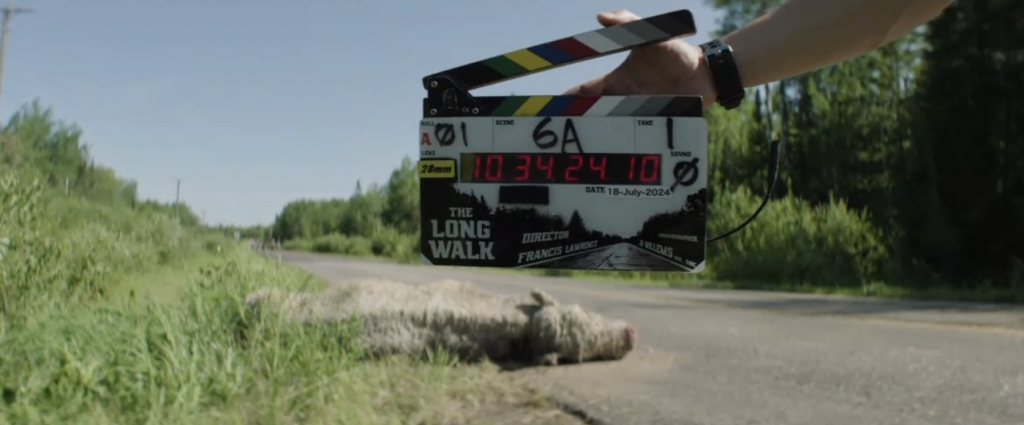
Eventually, we’d hit our end marks, cut, and everything stopped: that was my cue.
With just a minute or so before the unit reset for another pass, I’d bolt to the cameras for lens data, shoot the chrome/gray sphere, and colour chart, then grab reference photography. Last-minute stuff would often pop up, and we’d have to swivel and change plans. Time to troubleshoot on the fly. No time for panic buttons, just solutions. Shooting with natural light, the pace would pick up as the sun dropped toward the horizon. Immediate resets would be the response, leaving little to no time to grab consistent data, measures or photos. I’d have to prioritize: what could I get that would be the most useful in post? Going over each day’s decisions would fill the time on the long rides back to town at the end of the day.

ELEMENT DAY
Late in the shoot, we’d scheduled a day to shoot any elements VFX Supervisor Greg Ketel and the Distillery visual effects artists could use. Alongside the element photography, distortion charts were on the menu for the anamorphic lenses favoured by cinematographer Yo Willems. My day would be bouncing between several overlapping element shoots, shooting distortion charts, grabbing data and reference photographs and helping out wherever else I could.
The elements were intended as a visual reference to help with specular hits, blood colour, flying debris, and other details. The bulk of the work included bullet hits, exit wounds, and a pair of legs being crushed beneath a tank, all shot on blue screens. The leg-crushing gag was designed as a reference to the effects a heavy tracked vehicle would have rolling over a pair of legs.
Bullet exit wounds intended for heads and bodies were accomplished with small, pressurized tubes and pipes mounted into a proxy head form supplied by Makeup Department head Doug Morrow. Working in tandem with SPFX Supervisor Davin MacRae, the two determined air pressure levels, blood mixtures, and materials to be blasted from the wounds, filmed at high-speed frame rates. Several of these air-powered bullet exits were shot at the floor, to represent exit wounds and ricochets, as some walkers “got their ticket” lying on the ground.
To accomplish the leg-crushing gag, Makeup Department Head Doug Morrow first packed the hollow leg forms with a mix of materials representing muscle, bone and blood. A plank was placed on top of these, like a ramp, over which SPFX Supervisor Gavin MacRae drove a forklift, to simulate a tank tread rolling over the legs. Messy, but effective.

Makeup Department Head Doug Morrow
FINAL STEPS
Throughout the shoot, my second shift began at wrap.
I’d write up the VFX notes, transfer camera data, process HDRIs and reference photography, then organize set scans. During production days, I collected data on my iPad using a combination of a customized FileMaker Pro template and the ZoeLog app, making my life easier, keeping everything logged and organized. With the shot folders organized, everything got uploaded for the post teams in LA and Distillery VFX to be ingested into their respective pipelines. For a “light” vfx show, my hard drives were packed with camera data, scans, and photography files to process, organize and ship.

CLOSING THE LOOP
“Just walk with me a little longer.” – Ray Garrety
When I first read “The Long Walk” as a kid, I never imagined I would one day be working on the film. It was a long road getting there, and I couldn’t have asked for a better group of people to walk it with. What an adventure we had.
“Thank You” to Katie Adams Wells, Brianna Domont, Greg Kegel, and Daniel Revkin for kicking the ball my way.
A great behind-the-scenes video with director and cast interviews, sharing thier insights and experiences on the film here. Have a look at the trailer below.
